Numerical Model Analysis Theory
 Click to see Subtopics:
The underlying assumption of the analytical models for production data analysis is single-phase flow in the reservoir. In order to accommodate multiple flowing phases, the model must be able to handle changing fluid saturations and relative permeabilities. Since these phenomena are highly non-linear, analytical solutions are very difficult to obtain and use. Thus, numerical models are generally used to provide solutions for the multiphase flow problem. The numerical engine used in the software is a general purpose black-oil simulator (i.e., fluid composition is kept constant).
Numerical models can be created with fewer simplifying assumptions than analytical models. Multiphase behaviour (including effects of relative permeability and mass transfer between phases) and the change of rock and fluid properties with pressure can be incorporated rigorously.
Numerical models solve the nonlinear partial-differential equations (PDEs) describing fluid flow through porous media with numerical methods. Numerical methods are the process of discretizing the PDEs into algebraic equations, and solving those algebraic equations to obtain the solutions. These solutions that represent the reservoir behaviour are the values of pressure and phase saturation at discrete points in the reservoir and at discrete times.
The advantage of the numerical method approach is that the reservoir heterogeneity, mass transfer between phases, and forces / mechanisms responsible for flow can be taken into consideration adequately. For instance, multiphase flow, capillary and gravity forces, spatial variations of rock properties, fluid properties, and relative permeability characteristics can be represented accurately in a numerical model. In general, analytical methods provide exact solutions to simplified problems, while numerical methods yield approximate solutions to the exact problems. One consequence of this is that the level of detail and time required to define a numerical model is more than its equivalent analytical model.
Model Descriptions
Model descriptions are provided for these models: vertical, fracture, horizontal, horizontal multifrac, and extended horizontal multifrac.
Vertical Numerical Model
This model contains a fully penetrating vertical well in a discretized rectangular reservoir, and the well can be located anywhere within the reservoir. The "gridding" can be uniform or geometric; finer gridding can be generated around the wellbore. The model supports permeability anisotropy (i.e., kx, ky,and kz can be different).

Fracture Numerical Model
This model contains a fully penetrating bi-wing hydraulic fracture in a discretized rectangular reservoir, and the fractured well can be located anywhere within the reservoir. The gridding can be uniform or geometric, and the model supports permeability anisotropy.

Horizontal Numerical Model
This model contains a horizontal well in a discretized rectangular reservoir, and the well can be located anywhere within the reservoir. The model is subdivided into three layers in the vertical direction, and the model supports permeability anisotropy.

Horizontal Multifrac Numerical Model
This model contains a horizontal well with multiple fractures in a rectangular reservoir. This horizontal well is located in the center of the reservoir and is extended across the whole reservoir. All fractures are identical and are spaced uniformly across the well. With this model, you can specify permeability enhancement around each fracture and supports permeability anisotropy.
As the model is symmetrical, all the calculations are performed on one quarter of a fracture stage. This makes calculations relatively fast.

Extended Horizontal Multifrac Numerical Model
This model is similar to the Horizontal Multifrac Numerical model with the only difference being that this model can account for the region beyond the ends of the horizontal well’s lateral. Due to these additional end-regions, pressure transient behaves differently for different fracture stages; therefore it is not possible to perform calculations on one quarter of one stage. Instead, calculations are performed on one quarter of the entire model. As a result, calculation time for this model can be significantly longer than for the similar Horizontal Multifrac Numerical model.

If you believe that due to the small matrix permeability, the region beyond the horizontal well is not contributing during the production history, and will only contribute to the production forecast at a later time, we recommend the following:
1. Use the faster Horizontal Multifrac Numerical model to perform a history match.
2. Once the model is matched, create an Extended Horizontal Multifrac Numerical model with the same parameters; then add the region beyond the horizontal well lateral, as required.
3. Run a forecast for the Extended Horizontal Multifrac Numerical model.
In this manner, you will save time while matching the model, and will account for the contribution of the region beyond the horizontal well to the production forecast.
Differences between Black Oil, Gas Condensate, and Volatile Oil Models
To account for differences between black oil, gas condensate, and volatile oil models, we need to introduce various properties.
Black Oil and Modified Black Oil Properties
With the modified black oil PVT model, reservoir engineers can account for complex PVT behaviour that arises in gas condensate and volatile oil reservoirs.
Gas-condensate and volatile oil systems contain gas that may have non-negligible amounts of vaporized liquid hydrocarbons, and this may have a significant impact on fluid behaviour.
Common black oil numerical formulations do not consider changes in the liquid hydrocarbon content of the gas phase. In the modified black oil model, two new properties are added to account for the liquid contained in gas:
1. vaporized oil ratio (Rv).
2. dry gas formation volume factor (Bgd).
To explain these new properties, consider the figure below, which illustrates the distribution between the phases at given reservoir conditions. Excluding water, in both black oil and modified black oil modeling, it is assumed that there are two components (separator gas (G) and stock tank oil (N)), and two phases (gas phase (g) and oil phase (o)); and each of these components can exist in either phase. The amount of the produced gas at the separator is the summation of gas components that come from the gas phase (Gg), and the gas component that comes from the oil phase (dissolved gas, Go). Likewise, the stock tank oil (N) comes from both the oil phase (No) and the gas phase (vaporized oil, Ng):


Ng is neglected in the conventional black oil numerical formulation, but is honoured in the modified black oil numerical formulation.

The Vaporized oil ratio (Rv) for the gas phase is defined an being analogous to the solution gas ratio (Rs) for the oil phase. Physically, if a gas sample at reservoir conditions is brought to standard conditions, Rv describes the volume of hydrocarbon that will condensate into liquid, per volume of separator gas produced (typically expressed as bbl/MMscf). For a specific liquid-rich gas system, the vaporized oil ratio (Rv) is a function of pressure, temperature, and separator conditions. In Harmony, the Ovalle correlation for Rvis available.
Dry gas formation volume factor (Bgd) is another distinct modified black oil property. The wet gas formation volume factor (Bg) is defined as the ratio of the gas phase volume at a given pressure and temperature (Vg) to the equivalent volume of the whole gas phase at standard conditions:

The dry gas formation volume factor (Bgd) is the ratio between the volume of the gas phase at given conditions (Vg) to the volume of its gas component (Gg) at standard conditions:
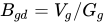
In conventional black oil applications, Ng is zero, which causes Bgdand Bgto become the same. However, for modified black oil applications, we need to differentiate between Bgand Bgd. Although there is no correlation available for Bgd, it can be calculated by using the following relationship between Bgand Bgd (Whitson and Brule, 2000):

where:
- α - conversion factor (1 bbl = 5.615 ft3)
- ρoST - oil density at standard conditions (stock tank)
- MoST - stock tank oil molecular weight
- R - universal gas constant
- TSC - standard condition temperature
- PSC - standard condition pressure
Numerical Modeling Using Modified Black Oil Properties
All the original (black oil) numerical models in Harmony (2013 v2 and older) use black oil properties. Therefore, the simulation results for gas condensates and volatile oil reservoirs may not be fully accurate in some cases. Particularly for gas condensate reservoirs, the original numerical models cannot predict the condensate drop-out in the reservoir, which affects both condensate surface yield and well productivity.
The Gas Condensate and Volatile Oil Numerical models use modified black oil properties; therefore the condensate drop-out is modeled correctly.
Gas Condensate Numerical models use the Gas Rate and Condensate Rate columns from the Production Editor as an input for production data. Condensate properties are set in the Properties Editor’s Oil section. The Gas Condensate Numerical model reports dry gas rates and condensate rates.
Volatile Oil Numerical models use the Gas Rate and Oil Rate columns from the Production Editor as an input for production data. The Volatile Oil Numerical model reports dry gas rates and oil rates.
Before a Gas Condensate Numerical model or Volatile Oil Numerical model starts a simulation, Harmony verifies that the properties entered into the simulators are physically meaningful. The model performs multiple property consistency checks, and if these checks don't meet the established criteria, an error or warning message will be displayed. The checking criteria are as follows:
pbp = pdew
Other checking criteria:
At any pressure:
co > 0
cg > 0
At any pressure where p ≤ pbp or pdew:
ρo ≥ ρg
1 / Rv ≥ Rs
Bgd / Rv ≥ Bo
Bo / Rs ≥ Bgd
μo ≥ μg
At p = pbp or pdew:
co (at p = pbp) ≥ co (at p > pbp)
cg (at p = pdew) ≥ cg ( at p > pdew)
Diffusion in CBM Numerical Models
The CBM numerical models simulate flow in the coal cleat using Darcy's law. However, it is also possible to model gas transport from the coal matrix to the cleat using either an instantaneous equilibrium or a pseudo-steady state, non-equilibrium desorption model.
The pseudo steady state, non-equilibrium model implies that gas transport from the coal matrix to the cleat is controlled by gas diffusion. It assumes that the gas concentration within the matrix is the same at any given time step. Gas flow from the matrix by diffusion is modeled with the following equation:

where:
- qm – gas production from the matrix
-
 – desorption time
 - Cm – matrix gas concentration
- Cequilibrium – equilibrium gas concentration at matrix / cleat boundary
Potential Errors in Numerical Models
There are several types of errors associated with the approximate nature of numerical solutions. The first type is called truncation error, which is caused by a truncated Taylor series expansion, and is used for the spatial derivative and time derivative. The order of truncation error is proportional to Δx (grid size) and Δt (timestep size). This implies that as Δx and Δt decreases, the truncation error decreases. However, decreased grid size and timestep size result in an increased number of computational operations; therefore computational time may significantly increase.
There is another kind of approximation that can result in one more type of error that is caused by the well model incorporated in the numerical model. In order to obtain the accurate wellbore pressure or flow rate, very fine grids around the wellbore are required. It is especially critical for compressible fluids and low permeability reservoirs. The best gridding method around the well is the cylindrical grid, but Cartesian gridding is the most common grid type used in the industry. In Harmony, vertical wells are modeled using the Peacemen well model. However, this model can overestimate the well productivity, and it also produces artificial wellbore storage effects during the early transient period.