Multilayered Wells
 Click to see Subtopics:
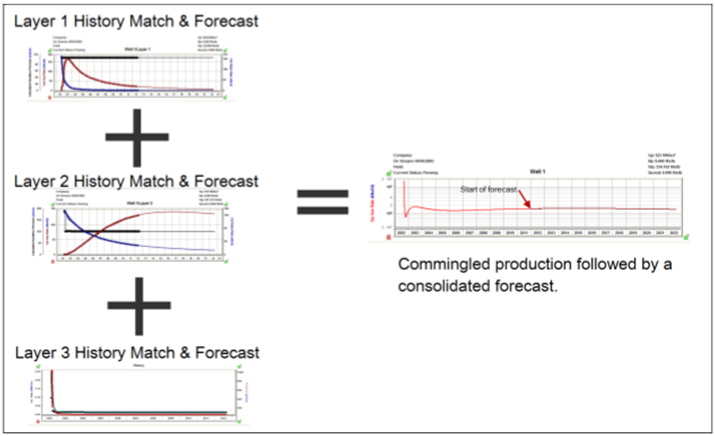
Many wells produce from a single formation (layer) economically, but occasionally a well is drilled that intersects and combines (commingles) the flows of two or more formations (layers), to bring flow rates up to economic levels. Such a well is called a multilayer well or a commingled well. For these wells, the reservoir dynamics cannot be sufficiently modeled using just one set of reservoir properties or just one analytical/numerical model.
Harmony provides a way of performing Multilayer Well Analysis, with the advantage of more accurately matching the reservoir dynamics than can be done with a typical single-layer modeling approach.

Multilayer Well Analysis and its Advantages
To model the flow dynamics of a layer, we need its rates and its sandface flowing pressures through time. However, measured data usually consists of the total commingled rates and the wellhead flowing pressures. Therefore, the first step is to import the rates and pressures for the well.
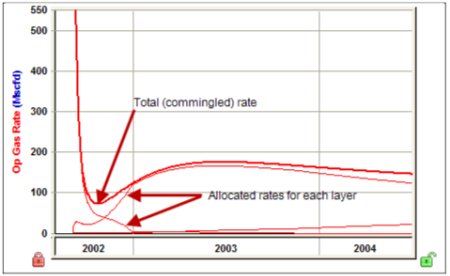
To get the rates and flowing pressures for each layer, we need to allocate the rates down to each layer. This is typically done by running a production logging tool (PLT) such as a spinner, or a fiber-optic-based distributed temperature sensor (DTS). Allocation measurements are made at points in time, and can be entered into Harmony.
Once the rates at each layer have been calculated using the allocation measurements, the wellbore converts the wellhead flowing pressure to the sandface flowing pressures for each layer. By having rates and flowing pressures for each layer, we have effectively divided our multilayer well into a set of single-layer wells all feeding into one wellbore.
Individual Layer Forecasts and their Consolidated Forecast