Linear Channel Flow Analysis
Subtopics:
Summary of Equations for Linear Channel Flow
Summary of Equations for Linear Channel Flow Derivative Analysis
Linear channel flow is a flow regime that exists in long, narrow reservoirs. It occurs in the transition between the middle time region and the late time region, when the radius of investigation (rinv) has reached the two closest parallel boundaries. The purpose of analyzing linear channel flow data is to determine the channel width (w).
Constant Rate Solution
For oil and water:
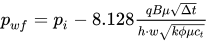
For gas:

Linear channel flow data will form a straight line when placed on a semi-log plot of pressure versus a square root time function (p vs. sqrt (time function)) for a buildup as shown below.

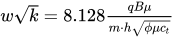
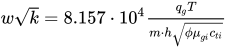
The slope (m) of this line is used to calculate the product of the channel width and the square root of permeability (w sqrt(k)) as follows:
For oil and water:
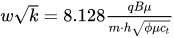
For gas:
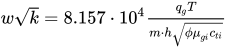
The permeability can be obtained from the radial flow analysis, or estimated from core data, or other tests. After permeability is determined, channel width is found using the following equation:

Summary of Equations for Linear Channel Flow (Field Units)
| Flow Period | Channel Width * Square Root of Permeability (ft md0.5) | |
|---|---|---|
|
Oil |
Drawdown
|
|
|
Buildup
|
|
|
|
Gas |
Drawdown
|
|
|
Buildup
|
|





Derivative
The signature of linear channel flow data on a derivative plot is a straight line with a slope of 1/2, between the middle and late time flow regions. The position of this line is used to calculate channel width and the square root of permeability (w sqrt(k)).
| Note: | The channel width and the square root of permeability increases as the position of this line moves to the right. |
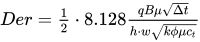
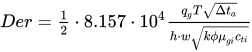
Starting with the constant rate solution (see above) the derivative with respect to the logarithm of square-root time is:
For oil and water:
For gas:
Taking the logarithm of both sides:
For oil and water:

For gas:

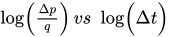
At long flow times, this result is linear with time, and as a result, the derivative of linear channel flow data falls on a straight line with a slope equal to 1/2 on a log Dp versus log Dt plot as shown below. Note that for shorter flow times linear equivalent time should be used to maintain a 1/2 slope.

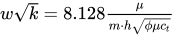
Using any derivative point on this line, the product of channel width and root permeability (w sqrt(k)). can be determined as follows:
For oil and water:

For gas:

Summary of Equations for Linear Channel Flow Derivative Analysis (Field Units)
| Flow Period | Channel Width * Root Permeability (ft md0.5) | |
|---|---|---|
|
Oil |
Drawdown
|
|
|
Buildup
|
|
|
|
Gas |
Drawdown
|
|
|
Buildup
|
|









References
"Pressure Transient Analysis of Wells in Very Long Narrow Reservoirs", R. Nutakki, L. Mattar; Society of Petroleum Engineers Paper 11221, 1982.