Pseudo-Steady State Flow Analysis
Subtopics:
Summary of Equations for PSS Flow
Summary of Equations for Pseudo-steady State Flow Derivative Analysis
Pseudo-steady state (PSS) flow is a flow regime that occurs in bounded (closed) reservoirs, after the pressure transient has reached all the boundaries of the reservoir. This includes not only the case of physically bounded reservoirs, but also the case of a well surrounded by other producing wells. In these situations, reservoirs exhibit tank-like behavior. The purpose of analyzing pseudo-steady state flow data is to determine the reservoir pore volume (Vp) and original hydrocarbons in place (OOIP or OGIP). This analysis is only applicable for drawdown or injection data when the well is flowing. There is no corresponding pseudo-steady state analysis for buildup or falloff tests.
Constant Rate Solution
For oil and water:

For gas:

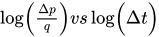
These equations are linear with respect to time, and as a result, pseudo-steady state flow data forms a straight line when plotted on a Cartesian plot of delta pressure over normalized rate versus delta time (Dp / q vs. Dt) as shown below.

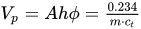
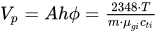
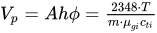
The slope of this line (m) is used to calculate the reservoir pore volume (Vp in ft3) as follows:
For oil and water:
For gas:
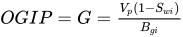
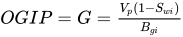
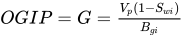
The reservoir pore volume is then used to calculate the original hydrocarbons in place as follows:
For undersaturated oil reservoirs (stbbls):

For gas reservoirs (MMscf):
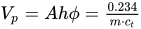
Summary of Equations for PSS Flow (Field Units)
| Flow Period | Reservoir Pore Volume (ft3) | Original Hydrocarbons In Place (MMscf or stbbls) | |
|---|---|---|---|
|
Oil |
Drawdown
|
|
|
|
Gas |
Drawdown
|
|
|



Derivative
The signature of pseudo-steady state flow data on a derivative plot is a straight line with a unit slope at late time. The position of this line is used to calculate reservoir pore volume (Vp) and the original hydrocarbons in place (OOIP or OGIP). Note that reservoir pore volume (Vp) and thus original hydrocarbons in place (OOIP or OGIP) increases as the position of this line moves to the right. The pseudo-steady state flow analysis cannot be applied to buildup or falloff test data.
Starting with the constant rate solution (see above) the derivative with respect to the logarithm of time is:
For oil and water:

For gas:

Taking the logarithm of both sides:
For oil and water:

For gas:

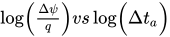
This result is linear with time, and as a result, the derivative of pseudo-steady state flow data on a log-log plot is a straight line with unit slope on a log Dp/q versus log Dt plot as shown below.

Notice that both wellbore storage (early time) and pseudo-steady state (late time) exhibit tank behavior and have a signature of a unit slope on the derivative plot.
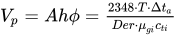
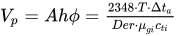
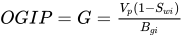
Using any derivative point on this line, the pore volume (Vp in ft3) and original hydrocarbons in place (OOIP (stbbls) or OGIP (MMscf)) can be determined as follows:
For undersaturated oil reservoirs:


For gas reservoirs:
Summary of Equations for Pseudo-steady State Flow Derivative Analysis (Field Units)
| Flow Period | Reservoir Pore Volume (ft3) | Original Hydrocarbons In Place (MMscf or stbbls) | |
|---|---|---|---|
|
Oil |
Drawdown
|
|
|
|
Gas |
Drawdown
|
|
|