
Last month we featured False Depletion. To see quiz answers, see Example C - 'MYSTERY' FALSE DEPLETION QUIZ.
Recognizing damage is probably one of the most interesting DST topics to non-specialists, for it can lead to finding bypassed production or "missed pay" in competitors wellbores or "additional pay" in your own wells.
The truth is that we cannot always identify damage from DST pressure behaviour. "Deep" or very severe damage is sometimes simply not possible to detect. This is because the radius of damage may be deeper than the radius of influence of the test.
There are other cases where the damage is not obvious from the test but there are "subtle clues" from closed chamber DST's or from the "air blow" descriptions or certain features of the chart.
We will cover these in future "Hugh Reid's Corner".
This month we will focus on simple "skin" damage, which can be recognized easily from the charts. It can often also be confirmed by computations using Horner Plots or type curves.
In fact the concept of "skin" was originated by a reservoir engineer Van Everdingen in the fifties.
Before examining his concept, let us look at the pressure behaviour from a well test or DST in an undamaged "homogeneous" reservoir.
In this diagram of a wellbore and formation being tested, a graph of pressure vs. time has been superimposed.
Times 1, 2, 3, etc. are increasing times during a flow period. The curved lines represent the pressure wave or "transient" travelling outwards into the formation. The longer the flow period the further the pressure disturbance has penetrated into the formation.
The pressure drop at the sandface
 p is the energy the formation
is using to flow at a given rate into the wellbore, which depends on the
permeability. The higher the permeability, the lower the p required. This is because there is
less "resistance" to flow with higher permeability or as a famous
Frenchman Henry D'arcy put it:
p is the energy the formation
is using to flow at a given rate into the wellbore, which depends on the
permeability. The higher the permeability, the lower the p required. This is because there is
less "resistance" to flow with higher permeability or as a famous
Frenchman Henry D'arcy put it:
p = Flow Velocity
x Resistance
where Resistance is 1/kh
so the tighter the rock, the more
resistance to flow and the higher the p (D'arcy Law simplified after N. Hannon).

If during drilling we have caused damage or a thin zone of reduced altered permeability around the wellbore, then we have created more "resistance" or an extra pressure drop around the wellbore so the pressure profile becomes as shown above.
So according to Mr. D'arcy:
p total = Flow Velocity
x Resistance of Rock + Resistance of Damage
p total = DST Flow
Rate x 1/kh rock + 1/kh damage zone
Now if we consider that the permeability damage zone may be only 25% or less of the permeability of unaltered original rock or kd = 0.25 ko, then there would be 4x the resistance due to the damage!
Thus we can expect a big pressure drop or drawdown with skin damage!
A DST gauge can be thought of as a receiver or even a Geophone if you like. As such what "signal" does it receive? Answer: The pressure disturbance. During flow as the pressure drop or "transient" moves out into the formation, it records pressure coming from an ever-increasing distance into the formation as per Figure 1 (rather like ripples in a pond after a rock is thrown).
During a shut-in period, the pressure wave moves back to the wellbore as the time increases.
Now a DST chart records the pressure returning to the wellbore with time so can be considered a graph of PRESSURE VS. DISTANCE into the zone SO THE PRESSURE PROFILE WE RECORD IS THE PRESSURE PROFILE INTO THE ZONE!
Let us look at a typical DST shut-in buildup from a moderately permeable undamaged zone.
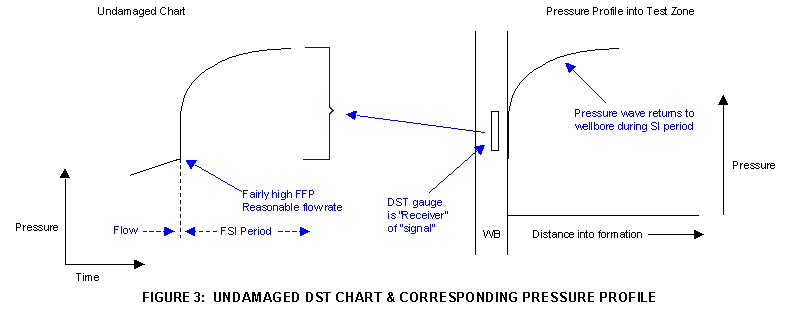
The pressure builds up fairly quickly as the k is moderate but it does take 15-20 minutes to reach reservoir pressure as the pressure wave has migrated some distance out into the wellbore after a typical 60 minute main flow period.
Now we examine in the same way a situation with obvious skin damage.
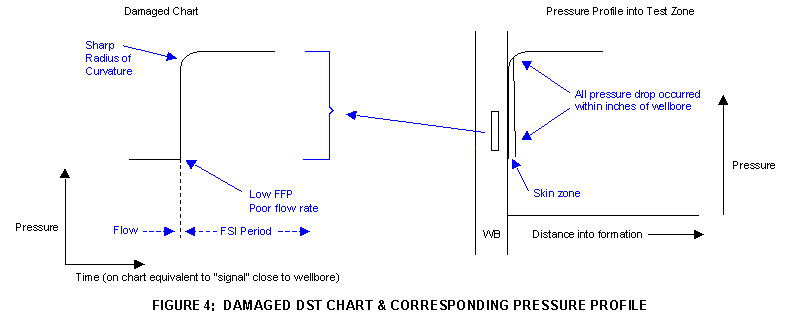
Here the pressure reaches reservoir pressure almost instantaneously (within 3-5 minutes perhaps) INDICATING THE PRESSURE WAVE HAD NOT MOVED OUT ANY DISTANCE INTO THE FORMATION, i.e., 95% OF THE PRESSURE DROP OCCURRED RIGHT AROUND THE WELLBORE.
In other words, the formation was using all its energy to flow through the extra resistance or skin-damaged zone.
So damage is really "wasted energy".
Putting all these features together, we can come up with the typical idealized chart of a damaged zone seen in DST courses, such as the one below taken from Figure 6-1 of Reid's DST course.

Figure 5 deals with a Liquid test — gas tests are dealt with later in this article.
In a liquids test, the slope of the flow curve is directly proportional to the rate at which the liquid fills the pipe. So in a badly damaged zone with low influx caused by the damage, the flow curve slope will be shallow.
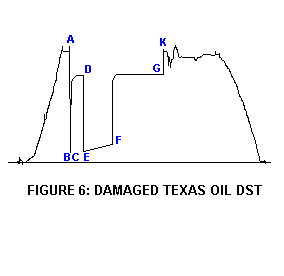
Let's look at a real example from the Permian Basin in West Texas:
WELL NAME: SUPERIOR STRAIN #24-1
LOCATION: 24 BLK 36 TIN Martin Co Tx (wildcat)
FORMATION: FUSSELMAN
DST 5 11167-283 ft. Bottom Hole Test. Mar. 1984
 Outside Recorder
PRD Make Kuster-3
No. 21808 Cap. 7975 @ 11283'
Press Corrected
Initial Hydrostatic A 6169
Final Hydrostatic K 6127
Initial Flow B 646
Final Initial Flow C 646
Initial Shut-in D 4863
Second Initial Flow E 690
Second Final Flow F 921
Second Shut-in G 4863
Third Initial Flow H --
Third Final Flow I --
Third Shut-in J --
Lynes Dist.: Midland, Tx.
Our Tester: Kirk Farrington
Witnessed By: Ken Allen
|
Did Well Flow — Gas |
No |
Oil |
No |
Water |
No |
(Test was reverse circulated) |
|
RECOVERY IN PIPE: |
|
|
|
Ran 1460 ft. of fresh water |
|
|
3020 ft. Total Fluid = 18.4 bbls. |
|
|
1460 ft. Water cushion = 9.63 bbls. |
|
|
1560 ft. Gas cut mud = 8.86 bbls. |
|
Blow Description: |
|
|
1st Flow: |
Tool opened with a weak blow and remained throughout the flow period. |
|
2nd Flow: |
Tool opened with a weak blow and increased to 4oz. In 15 minutes, to bottom of bucket increasing to 16oz. In 120 minutes. |
In this test the overall shape is fairly close to the idealized Figure 5. Let's tick off the text book features.
The quick buildup from F to G is quite obvious.
The permeability is evidently high.
The flow curve slope during main flow E to F is fairly low (275 psi over 150 minutes) is approx. 1.8 psi/min. Taking account of the D.P. size and mud gradient this represents a flow rate of only 36 B/D of mud. (Note the water cushion of 1460 ft. weights only 646 psi (Point B) which is only 13% of the reservoir pressure (Point G) 4863 psi, so it cannot be "blamed" for the poor performance.)
The Drawdown (G-F) of 3942 psi is very large amounting to 81% of the reservoir pressure (G) 4863, i.e., the zone is using 81% of its energy to make a mere 36 B/D!
Other things of interest: So far we know the zone is suffering damage but do we know the zone content?
Here are a few clues:
Gas Presence
 The air blow
suggests the zone was co-producing low rate gas. Notice the weak blow
during the 5 minutes preflow and 15 minutes of second flow (indicating
the gas is still below the rising cushion and mud recovery.
The air blow
suggests the zone was co-producing low rate gas. Notice the weak blow
during the 5 minutes preflow and 15 minutes of second flow (indicating
the gas is still below the rising cushion and mud recovery.
Then notice the
increase to 4 oz. in 15 minutes. (ð 7" underwater blow where 28" H20
= 1 psi) indicating the gas broke through the cushion and was expanding
in the air-filled drillpipe.
Finally the increase to 16 oz. Indicates
an air blow resembling a "boiling kettle" reflecting the increasing
gas influx.
The fact that these sudden increases
in air blow are not reflected in any sudden increase in gas flow curve
slope confirms the air blow response is due to gas not liquid (a 36 B/D
liquid influx would generate a steady, very weak blow only).
Liquid Presence
The continuously
rising flow curve tells us that the zone is co-producing liquid. Very
low rate gas which only resulted in a surface pressure rise of 1 psi (16
oz.) cannot generate a downhole flow pressure rise of 231 psi (F-E).
Sample Chamber Contents
2600 cc. gas-cut mud + trace gas.
Zone Content
So far we know the well was co-producing minor gas and low rate liquid. This could indicate:
a gas water contact
a deeply invaded gas zone
an oil zone evolving solution gas.
Salinity Data
Top Recovery 200,000 + ppm
Middle Recovery 200,000 + ppm
Bottom Recovery 200,000 + ppm
Sampler 110,000 ppm
Mud Pit 165,000 ppm
Since the top, middle and bottom samples are all the same, this means we have not recovered any formation water. The mud pit sample shows a salt mud was used. The sample chamber is the "odd man out". It may indicate some dilution by a fresher formation water, however sample chamber salinities are very frequently the least reliable of all the samples. (This may indicate incomplete flushing/cleaning from the last job.)
So the salinities don't suggest a water zone although we still can't prove it is an oil zone!
All we know is that it is a highly damaged liquid zone. In this writer's experience it is hard to severely damage 100% water zones — DST's of water are either tight or permeable and prolific, very rarely damaged so I would "lean" to it being oil or at least some oil content.
Potential Deliverability
Damage ratio (DR). A Horner analysis gives a DR of 12.5 hence the potential rate if we could successfully remove the damage = DR x DST rate = 12.5 x 36 B/D = 451 B/D
RESULTS AFTER COMPLETION
Perfs: 11,188-11209 ft. (i.e., within DST interval of 11167-11283 ft.) — no new zone opened up.
IP: 426 BO + 12 BWPD. June 2, 1984