Oil IPR / TPC Analysis Theory
 Click to see Subtopics:
When the objective is to determine the optimal way to complete a well, a common method is nodal analysis. Nodal analysis combines two separate concepts, inflow performance relationship (IPR) and tubing performance curve (TPC), and plots them on the same chart where you can see how each well may operate under a number of conditions. Since both the IPR and TPC are calculated independently, the theory for each concept will be described separately below.
TPC
A tubing performance curve is a graphical representation of the pressure response of a wellbore completion to a range of fluid rates. In Harmony, it is plotted as a relationship between sandface flowing pressure vs. oil rate.

The inputs needed to create a TPC curve are as follows:
- Wellhead pressure
- Ratios (GOR and WOR)
- A valid wellbore configuration
See Wellbore Editor for details. - Valid fluid properties
See Properties Editor for details.
Using these inputs, a series of pressure loss calculations are done over a range of oil rates, and then a line is drawn through all the points to create a curve. The default setting is to plot 64 points, using equally spaced oil rates up to a predetermined maximum rate. However, both the maximum rate and the number of rates used for plotting may be set using the IPR / TPC Solver settings. In all cases, the minimum oil rate is fixed at 1.0 stb/d.
IPR
Flow into a well depends on both the reservoir characteristics and the sandface flowing pressure. The relationship of inflow rate to sandface flowing pressure is called the inflow performance relationship (IPR). Harmony presents this relationship in the form of a pressure versus flow rate plot. From this plot, the well’s flow potential can be determined at various flowing sandface pressures.
Straight Line IPR
In calculating oil well production, it is assumed that producing rates are proportional to the pressure drawdown. Using this assumption, a well’s behaviour can be described by its productivity index (PI) as follows:
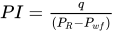
This relationship was developed from Darcy’s law for the steady-state radial flow of a single, incompressible liquid. An example of a straight line IPR is shown below.

In order for oil to flow from the surrounding reservoir towards the wellbore, there must be a pressure drawdown. Consequently, if the flowing sandface pressure (pwf) is equal to the reservoir pressure (pR), then no oil will flow from the reservoir to the wellbore, and therefore the rate is zero. Consequently, for any IPR graph, the y-axis intercept is essentially an indicator of the reservoir pressure.
Likewise, if the sandface pressure is zero, then the drawdown would be at its maximum value, indicating the theoretical maximum rate that the reservoir could deliver to the well. This maximum rate is sometimes referred to as the absolute open flow potential (AOFP), and is indicated by the x-axis intercept on the plot. Since an absolute sandface pressure of zero is a physical impossibility, the AOFP cannot be measured. Instead, a test is performed to measure the rate that the reservoir delivers at some intermediate sandface pressure. This test information, along with the reservoir pressure, is used to determine the productivity index. Consequently, the AOFP can be calculated from the productivity index equation.
Vogel IPR
While a straight line IPR is quite applicable for single-phase liquid systems (e.g., a water reservoir), it is less accurate for two-phase systems. Since reservoir oil contains dissolved natural gas, and this gas evolves from the oil below the bubble point pressure (pbp), a two-phase scenario is a common occurrence in an oil reservoir.
Vogel developed the following empirical equation to account for two-phase flow.

An example is shown below.

IPR with Both Single-Phase and Two-Phase Flow
Vogel's equation was derived for reservoirs whose bubble point pressure was equal to the reservoir pressure. For undersaturated reservoirs (i.e., reservoir pressure higher than bubble point pressure), the straight line IPR equation applies for sandface pressures above pbp while the Vogel IPR equation applies for pressures below pbp.