Volumetric Analysis Theory
 Click to see Subtopics / Related Topics:
Volumetric analysis is a technique that employs geological observations and information to estimate original fluids-in-place. It is often referred to as a "static method” as it primarily sources its data from core samples, wireline logs, and geological maps. Volumetric calculations are typically used prior to production to estimate reserves, and after considerable production to determine the efficiency of recovery, the areal extent of the reservoir, and as a basis for advanced studies such as reservoir simulations.
| Volume Parameter Equations and Equalities | |
|---|---|
|
Rock Volume |
|
|
Pore Volume |
|
|
Hydrocarbon Pore Volume |
|



A comprehensive geologic study of the prospect is necessary to increase the confidence and reliability of determined reservoir properties such as volume, porosity, and fluid saturations. In calculating the volume of the reservoir, accurate determinations of the areal extent and thickness must be made with respect to the geological structure and depositional environment. The use of isopach maps in combination with planimetering is a commonly used method in the determination of reservoir volume. Conclusions drawn concerning lithofacies and depositional settings are used to provide an assessment of porosity, while wireline log and core data provide the analyst with measurements of fluid saturations.
Oil Reservoir Calculations
| Original Oil-in-Place (OOIP) Calculations | ||
|---|---|---|
|
Field Units [stb] |
|
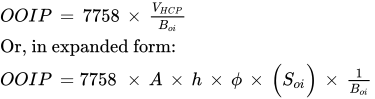
Where: A = acres h = feet φ = % Soi = % Boi = bbl/stb |
|
Metric Units [m3] |
|
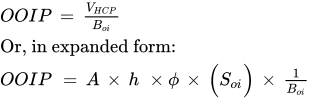
Where: A = square meters h = meters φ = % Soi = % Boi = m3/m3 |
Gas Reservoir Calculations
Historically, in a gas reservoir, only free gas-in-place was considered. Because of this, only one name was required: OGIP. However, with the increasing use of adsorbed gas reservoirs in the industry, Fekete / IHS has adopted the name “OGIPF” to define the gas-in-place for a free gas reservoir. Likewise, the name “OGIPA” is used to define the gas-in-place in an adsorbed reservoir. The name OGIP has been retained to describe the total original gas-in-place.

Free Gas Equations
| Original Free Gas-in-Place (OGIPF) Calculations | ||
|---|---|---|
|
Field Units [scf] |
|
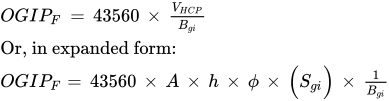
Where: A = acres h = feet φ = % Sgi = % Bgi = ft3/scf |
|
Metric Units [m3] |
|
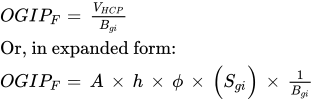
Where: A = square meters h = meters φ = % Sgi = % Bgi = m3/m3 |
Adsorbed Gas Equations – Shale Reservoirs
Shale gas reservoirs usually contain much more adsorbed gas than free gas. Therefore, OGIP calculations for shale reservoirs should also account for adsorption. For shale reservoirs, the following equations are used to calculate Original Adsorbed Gas-in-Place (OGIPA).
| Original Adsorbed Gas-in-Place (OGIPA) Calculations | ||
|---|---|---|
|
Field Units [scf] |
|
Where: A = acres h = feet ρb = ton/ft3 p = psi(a) VL$ = scf/ton pL$ = psi(a) |
|
Metric Units [m3] |
|
Where: A = square meters h = meters ρb = g/cm3 p = kPa(a) VL$ = cm3/g pL$ = kPa(a) |


Note: For the theory of adsorption, see Shale Properties.
CBM Reservoir Calculation
In a CBM reservoir, adsorbed gas is the most important factor when calculating OGIP. Free gas, if it exists at all, usually accounts for only a small percentage of the total gas-in-place. The calculation of adsorbed gas in CBM is similar to that for shale gas, although a few extra parameters are considered.
| Original Adsorbed Gas-in Place (OGIPA) Calculations | ||
|---|---|---|
|
Field Units [scf] |

|
Where: A = acres h = feet ρb = ton/ft3 Cgi = scf/ton Ca = % Cw = % |
|
Metric Units [m3] |

|
Where: A = square meters h = meters ρb = g/cm3 Cgi = cm3/g Ca = % Cw = % |
Note: To view the calculation of Cgi, see Langmuir Isotherm. Free-gas calculations are the same for all gas reservoirs.
Abandonment of CBM Reservoirs
CBM reservoir abandonment can be determined by recovery factor, pressure, or carbon dioxide concentration. All three are user-defined, and are based on economics. In Harmony, abandonment by pressure or carbon dioxide concentration is available under the same menu, although only one of the factors needs to be specified for a calculation to occur. Please note that if abandonment pressure is not defined, it is assumed to be 0 psi(a)/kPa(a) by the software. Likewise, if (CO2)ab is not defined, it is assumed to be 100%.