
We can recognize damage in gas DST's in much the same way as liquids, by looking for rapid stabilization of S.I. pressure but very low flowing pressures indicating low flow rates; the only difference is that the flow pressure behaviour is much more variable than in liquids.
Figure 1 shows the typical features and explanations for the variation in flow curve shapes.
Here is a very interesting case history involving a geologist who was a student at one of my DST short courses.
It is often the case with courses that "if you don't use it you lose it". Fortunately he was able to use some of the knowledge gained at the course shortly after he got back to the office.
Here's what happened:
A gas zone in the Charlie Lake gave an initially discouraging DST result of gas at approx. 50 mscf/D plus a minor recovery of mud. These results initially led to the impression that the zone should be abandoned and other zones with better DST results be completed. Fortunately the DST charts were examined before coming to a final decision.
A portion of the DST report is shown below in Figure 2. Let's have a look at the data.
LOCATION: WORSLEY AREA (T86 W6M)
FORMATION: TRIASSIC CHARLIE LAKE FM.
DST 1 996-1004m. Inflate Straddle Test, February 26/96.
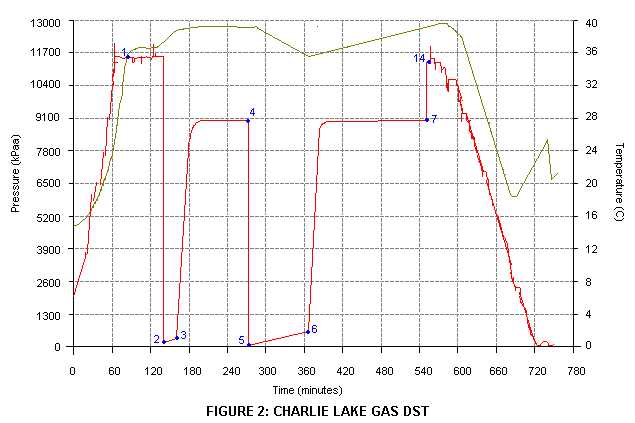
Pressure (kPaa) at Critical Points:
1: 11373 2: 170 3: 214 4: 9048 5: 41 6: 351 7: 9039 14: 11358
Recovery Description
5.00 m drlg mud
Gas Measured with Floor Manifold
Flow # Time Surface Choke Surface Pressure Gas Rate
(min) (mm) (in.) (kPag) (m3/day) (mscf/day)
2 20 6.35 ¼ 30 453 16
2 30 6.35 ¼ 70 967
2 40 6.35 ¼ 100 1149
2 50 6.35 ¼ 110 1210
2 60 6.35 ¼ 120 1270 45
2 70 6.35 ¼ 140 1391
2 80 6.35 ¼ 140 1391
2 90 6.35 ¼ 140 1391 49
A more classic "text book type" example could hardly be found!
Let's check off the clues from this Charlie Lake DST:
1. The extremely depressed flowing pressure of only 351 kpa (41 psi) and low gas rate average 45 mcf/D.
2. Couple this with the very rapid buildup to stable reservoir pressure (most pressure loss occurred right around the wellbore).
3. These two items result in the huge drawdown (point 7-6) of 8688 kpa (1259 psi) amounting to 98% of reservoir pressure. The well was using 98% of its energy to make a mere 45 mcf/D! In effect this almost represents its AOF in its damaged condition!)
Note that the very low flowing pressure/rate by itself does not indicate damage, as tight wells have low flow pressures.
Also the rapid buildup by itself does not mean damage as very permeable/non-damaged wells can stabilize rapidly. It is the combination of those two features that points to damage.
Gas Rates
The fact that the measure gas rates were apparently rising for the first hour is encouraging — even though these rates are teeny — they have apparently increased by a factor of 4x. Such behaviour is usually referred to as "the zone cleaning up" and is another indication of damage in gas zones.
What will it make if we stimulate?
The service company made a routine Horner Plot and analyses yielding a very high damage ratio (DR) of 17.4 (usual value rage from 2-5 in damaged wells).
This would imply that if the damage could successfully be removed, the zone would flow at 17.4x the DST rate:
Hence 17.4 x 49 mscf/D = 855 Mscf/D (24222M3/D)
Numbers like this start to look economical if the analysis is correct.
Furthermore, by multiplying the DST rate by the damage ratio, we arrive at the rate expected with removal of the damage alone, i.e., with zero skin damage but on can usually increase this with a "frac" by improving the zone over its natural condition (skin = -4 for the engineering audience) so this bumps us up to 1.7 MMscf/D.
How about water problems?
Any time we anticipate fracing a well, we should check that the DST is not co-producing water, otherwise we might frac into the water!
In this case the recovery is only 5m mud, so not a problem, if reported correctly.
All looked favourable so - well was cased to 3461 ft. (1062m), i.e., to 58m below the DST interval.
Zone was stimulated and flowed at 3 to 4 MMscf/D.
At present the well is producing from a shallower Bluesky zone but the Charlie Lake is now behind pipe ready for perforation when the operator chooses to do so.
This example obviously "worked" and shows how sometimes the obvious and simple qualitative chart analysis can pay off.
There are however some more subtle points we didn't discuss which we ask about in the quiz game below.

1. In Figure 2, what is the cause of the flowing pressure rise? (refer to Figure 6 for ideas)
2. In Figure 2, was the well really cleaning up? i.e., were sandface rates increasing? (This one is quite hard. For "pros" — we know the surface rates were increasing but how about the downhole rates?)
3. Why is the second SI buildup more rapid than the first (related to Question 2)?
4. In Figure 2, why did the temperature drop during the main flow but not the preflow?
Questions 1-3 are related to damage but Question 4 is general knowledge.
Here are the DST results from an old D&A well.
 LOCATION: Twp 36 W4M
DST 2: 4720-4785 ft. Bottom
Hole Test
FORMATION: Glauconitic DATE:
October 1964
Recorder: Outside Rec. No.: 1027
Capacity: 5600
Depth: 4740
1. 2320
2. 230
3. 1211
4. 100
5. 106
6. 1153
7. 2265
FIGURE 3 – CASE HISTORY – A REDRILL BY RENAISSANCE RESOURCES IN 1979
Fifteen years later, Renaissance Resources twinned this well (in 1979). (They moved over 117 ft. from the old wellbore.)
1. What led them to believe this zone was damaged?
2. Can you account for the flow curve being horizontal?
3. Is the large overbalance significant?
4. Does this test show any signs of depletion? (see Skin Damage in Oil Zones for clues!)
5. In the redrill, this zone was retested with an inflate straddle after drilling through with a slightly heavier mud. What do you think the test results would be compared to the original hole?
6. Can you "ballpark" guesstimate what this might produce with damage removed? (Just a guess is required since no analysis is provided.)
In a future edition of Hugh Reid's Corner, we will show the twinned well DST.